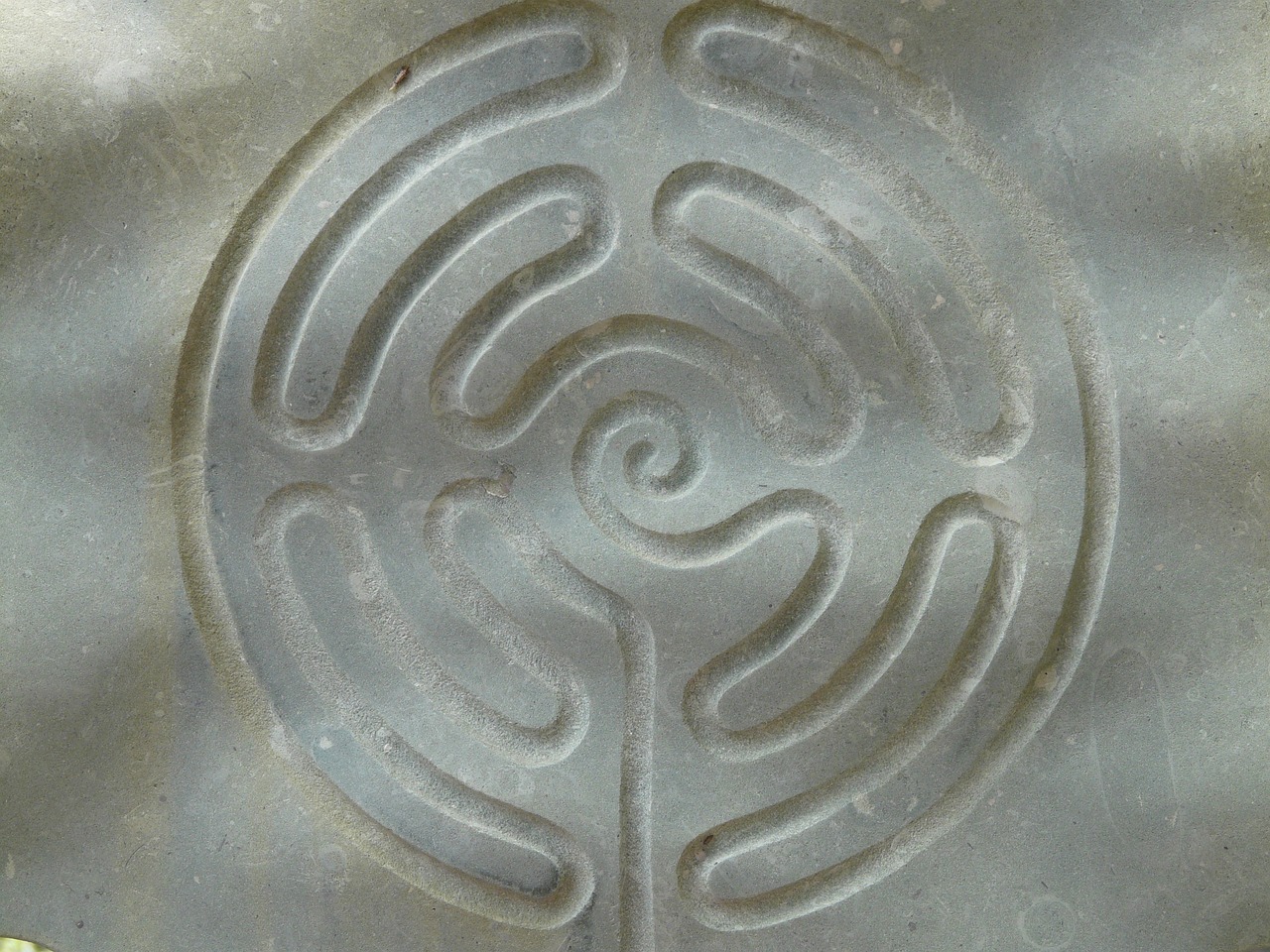
I love moving labyrinths, especially in the company of others. There is an expectation that we all eventually get to the centre and we all come out from that circle. Apart from those expectations, there is space for each of us to imagine and experience it in our bodies as well as our minds. As a practical theologian, the spiral is often a metaphor for connecting action with reflection or experience with learning. The spiral allows teachers to accompany students who may be at different stages or require different supports while the structure of the path and the bounds of the circle allows students to have a sense of what is at the centre of our journey together. The teacher creates the space, understands the overall journey, and asks questions or sparks learning throughout the process. The centre will transform in different contexts.
Disability studies scholar and professor Tanya Titchkosky writes about how disabled students are often “unexpected” and “unimagined”[1] in classrooms. Though this may begin to shift, this has been true in seminary, where there are spoken and unspoken norms around who offers and who receives leadership. In my teaching practice, I strive to expect and imagine how disabled students can shape the classroom. This is partly why I disclose my disability in my course policy: “As well, you will see that I (your teacher) live with a physical disability that impacts my speech. Listening to me, and to others with different speech patterns, requires patience and practice on all of our parts.” I will strive to create space for us to imagine leadership differently and hope students will use this imagination in their future ministry settings.
[1] Tanya Titchkosky, The Question of Access: Disability, Space, Meaning, 2 edition. (Toronto: University of Toronto Press, Scholarly Publishing Division, 2011).
 Miriam Spies